Holcombville School House: A One-Room Survivor of Rural McHenry County
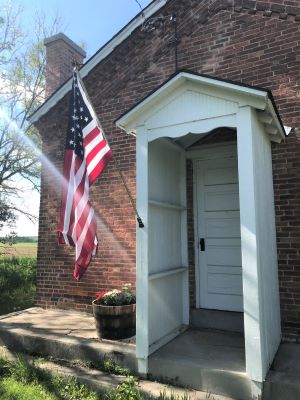
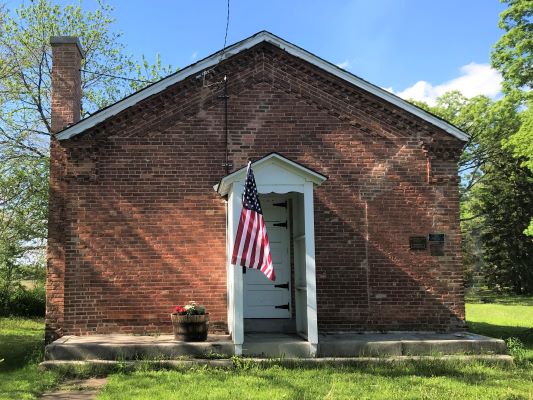
Hidden along the rural edge of the Crystal Lake and Bull Valley area, Holcombville School House is easy to overlook. A modest red-brick building with a white entryway and an American flag, it stands as one of the best-preserved reminders of rural education in McHenry County, Illinois. Though small in size, the schoolhouse tells a much larger story about early settlement, community life, and the evolution of public education in northern Illinois.
Origins of the School
The Holcombville School House was built in 1858 after local school directors purchased one-half acre of land from Sutherland Ingersoll for $12.25. The school and nearby cemetery were named after the Holcomb family, among the earliest settlers in the area.
Historical accounts indicate that the brick structure replaced an earlier wood-frame school that had served local children for approximately twenty years. This suggests that organized education in the Holcombville area dates back to the late 1830s, shortly after the first permanent settlers arrived. William Holcomb and other pioneering families played a significant role in establishing both the community and its educational institutions.
Architecture and Construction
Although simple in appearance, the schoolhouse contains several notable architectural features. McHenry County preservation records describe the building as a simplified Federal-style structure. Decorative brickwork along the roofline represents dentils and cornice returns commonly found in more formal buildings of the era.
The building's outer walls flare slightly toward the base, a practical design intended to direct rainwater away from the river-stone foundation. Inside, visitors can still see original blackboards and an embossed tin ceiling, both rare survivals from nineteenth-century rural schools.
The school's remarkable state of preservation is due in part to what happened after it closed: nothing. Unlike many one-room schoolhouses that were converted into homes, storage buildings, or businesses, Holcombville School House remained largely untouched.
Life Inside a One-Room School
For nearly ninety years, Holcombville School served students in District 43. Like most rural schools of the era, a single teacher instructed children from first through eighth grade in the same classroom.
Students often walked miles from surrounding farms to attend classes. A typical day included reading, writing, arithmetic, geography, history, and civics. During winter months, a wood or coal-burning stove heated the room, while recess brought students outdoors for games and recreation.
One of the school's most well-documented teachers was Nellie Doherty. A former student herself, Doherty returned in 1919 to teach at Holcombville. Her contract required her not only to educate students but also to perform all janitorial duties. She reportedly earned $72 per month while teaching as many as twenty-five students across multiple grade levels.
Former students remembered that education at Holcombville emphasized both academics and character. Teachers were expected to cultivate citizenship, responsibility, and moral development alongside traditional classroom subjects.
The End of an Era
Holcombville School House remained in operation until 1946. By that time, educational consolidation was transforming rural America. Improved roads, school buses, and larger centralized schools made the one-room schoolhouse increasingly obsolete.
Throughout Illinois and the Midwest, hundreds of small rural schools closed during the first half of the twentieth century. Holcombville was one of many that fell victim to consolidation, but it was unusual in surviving intact after its closure.
Historic Preservation and Landmark Status
Today, Holcombville School House is recognized as a historic landmark by the McHenry County Historic Preservation Commission. The designation acknowledges both its architectural integrity and its importance as a rare surviving example of nineteenth-century rural education.
The building remains one of the most authentic one-room schoolhouses in the county. Original features, educational artifacts, and its rural setting allow visitors to experience a tangible connection to the educational practices of an earlier era.
The Holcombville Cemetery Connection
Adjacent to the school is Holcombville Cemetery, which preserves the history of many of the area's earliest settlers. Families such as the Holcombs, Stickneys, and Terwilligers helped establish the community and are buried nearby.
Together, the cemetery and schoolhouse form a unique historical landscape that tells the story of settlement, family life, education, and community development in rural McHenry County.
Why Holcombville Matters
The significance of Holcombville School House extends beyond architecture. It represents an era when education was deeply local and rooted in community identity. One teacher, one classroom, and one building served generations of children from surrounding farms.
As suburban development continues to reshape northern Illinois, Holcombville remains a rare and powerful reminder of the county's agricultural past. Its preservation offers future generations an opportunity to understand how education was delivered before consolidation, modern transportation, and large school districts transformed the American educational landscape.
More than a historic building, Holcombville School House is a surviving witness to nearly a century of rural life, community effort, and educational history in McHenry County.
References
- McHenry County Historic Preservation Commission – Landmarks
- McHenry County Historic Preservation Program
- Naturally McHenry County – Holcombville School House
- McHenry County Living – One-Room Schoolhouses
- Shaw Local – One-Room Schoolhouses Provide a Glimpse into McHenry County's Past
- Nunda Township – Holcombville Cemetery History
- McHenry County Historical Society & Museum
- Illinois Digital Archives